
Document of the Month 4/26: A Summons Letter to Tax Collectors
Watching the Taxman? Oversight and Fiscal Accountability in Khurasan Seen Through One Document in the Bamiyan Papers
by Arezou Azad
The tax season is upon many of us, and nothing is more complicated than taxes, as Albert Einstein is purported to have said.1 While Einstein was speaking as a taxpayer, others like Chris Wickham have referred to the “terrors” that tax collectors faced in late antiquity and the early Middle Ages in Europe. He wrote:
Peasants were relatively straightforward to terrorize…but their lords were less easy game. Small wonder that tax-collectors travelled with armed support, in the Roman empire as in most other strong states. Unless one really needed to tax, it is hard to imagine that its rituals could have prevailed against so many structural opponents.2
Who does watch the taxman? As a research project interested in Khurasan, the Invisible East team examined documents belonging to a 12th-century warehouse manager charged with collecting grain taxes on behalf of the state in Bamiyan, and found some tentative answers in one document: NLI, Ms.Heb.8333.44 (Figure 2).3 The document is preserved amongst the Bamiyan Papers (aka “Afghan Geniza”) purchased by the National Library of Israel (NLI) in 2016.
NLI, Ms.Heb.8333.44 within its archival context
The entire warehouse archive, encompassing as many as 120 documents, includes a dozen documents from the early 1200s that pertain to two specific tax collectors. Their names are variably written and can be identified as Jamāl al-Dīn Muḥammad b. Maḥmūd and Shujāʿ al-Dīn Muḥammad b. Ḥasan. They are qualified with the official title of shiḥna (police) and are often further referred to as muḥassil-i ghalla (tax collectors). Whether these two men were in the employ of the fiscal administration (diwan), to which the state warehouse reported, or were seconded by the police service to the diwan, or acted as contracted tax farmers, is not clear.
What is clear is that they were obligated to sign legal documents that testified to their holding of grain taxes, effectively in escrow, before their transfer to the state warehouse in Bamiyan (probably requiring several days of mounted travel from agricultural areas in which the shiḥna were deployed).4 In the Bamiyan Papers, the shiḥna officers’ law enforcement mandate applied to all private individuals in their area of jurisdiction (in this case, the fertile Ghorband and Panjshīr river valleys, Figure 1). The same pressures mentioned by Wickham were real for tax collectors working for the Bamiyan sultanate in the early 1200s in the villages and estates (over a 250 km radius).

Fig. 1: The Panjshīr River valley. Wikimedia, public domain. CC BY-SA 3.0
Within the fiscal administration, tax officials were therefore not autonomous. They reported upward through tiers of administration, and their accounts were expected to be checked and countersigned. Administrative writers like Qudāma ibn Jaʿfar (fl. 289–95/902–8) described the importance of record comparison and verification, which was a clear attempt to discipline officials through paperwork.5 But it is only now that we can explore the extent to which these prescriptions were implemented, and how.
NLI, Ms.Heb.8333.44: A close-up view
Document NLI, Ms.Heb.8333.44 (Figure 2)6 is undated, but from the other dated documents referring to the two tax collectors, Jamāl al-Dīn Muḥammad b. Maḥmūd and Shujāʿ al-Dīn Muḥammad b. Ḥasan, we can place its issuance around the year 614/1218. The document is written on paper, like all 222 items in the Bamiyan corpus. The size of the paper is ca. 11.0 ×13.5 cm, and the image reveals three horizontal fold lines. The sender’s name has been obscured by a tear in the top of the paper, but it may have been Muḥammad and/or ʿAlī b. Najīb (the sender’s name contains a distinctive pious phrase), who appear in other documents of this period as the head of the fiscal diwan.
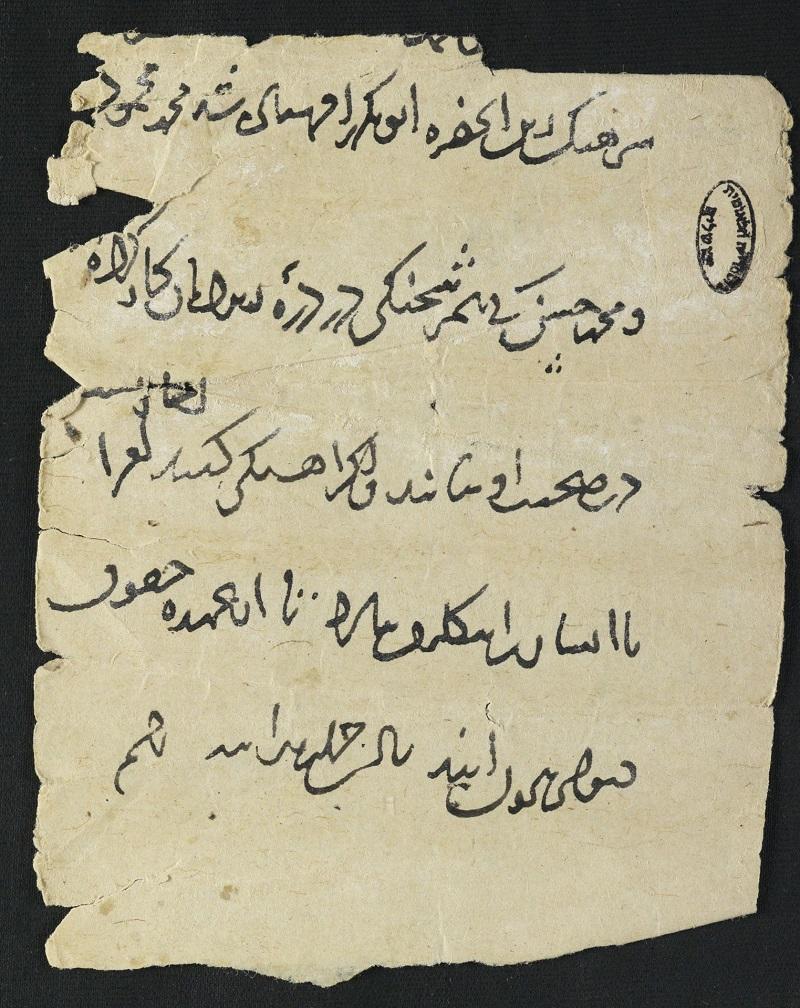
Fig. 2: Letter of summons. NLI, Ms.Heb.8333.44 recto, undated, ca. 614/1218. Full details of the document can be found in the Invisible East Digital Corpus.
Transcription
1. لله [الحـ]ـمد ... (؟)
2. سرهنک زینالحضره ابوبکر را فرستاده شد محمد محمود
3. و محمد حسن کی بامر شحنگی در درۀ زیردمان (؟) کار کرده[اند]
4. در صحبت او بیایند و اکر اهستکی کنند او را اجازتست
5. تا ایشان را بتکلیف بیارد تا از عهده حقوق
6. دیوانی بیرون ایند بر این جمله بدانند ...(؟)
Translation
1. [Praise] is for God ...(?)
2. The commander Zayn al-Ḥaḍra Abū Bakr7 has been sent
3. [so that] Muḥammad b. Maḥmūd and Muḥammad b. Ḥasan, who have been working as shiḥnas in Zīrdamān Valley (?),
4. come back with him. If they tarry, [Abū Bakr] is permitted
5. to retrieve them with force, so that they
6. meet their obligations8 to [transfer the requisite] diwani taxes.9 They should take note of this. [merciful?]
Oversight measures in NLI, Ms.Heb.8333.44
The document hints at an inquiry, and we must presume that it involves a fiscal discrepancy that the diwan identified and which pointed to the taxmen on the ground as the source. Implicated in this discrepancy is the same duo of shiḥna officers encountered in the legal documents as tax collectors, Jamāl al-Dīn Muḥammad b. Maḥmūd and Shujāʿ al-Dīn Muḥammad b. Ḥasan. The sending diwan officials state in their letter that the letter carrier, a certain commander called Zayn al-Ḥaḍra Abū Bakr, has been sent to apprehend them. The letter warns that if the shiḥna officers refuse to cooperate, they will be forcibly removed from the Zīrdamān valley at which they are stationed (the name Zīrdamān may refer to a place in the foothills of the Damān mountains, perhaps near modern-day Parwān, where the Ghorband and Salang Rivers converge, see Figure 3). The language is strong and forthright. There was probably little the taxmen could do to avoid appearing for the inquiry at the capital.
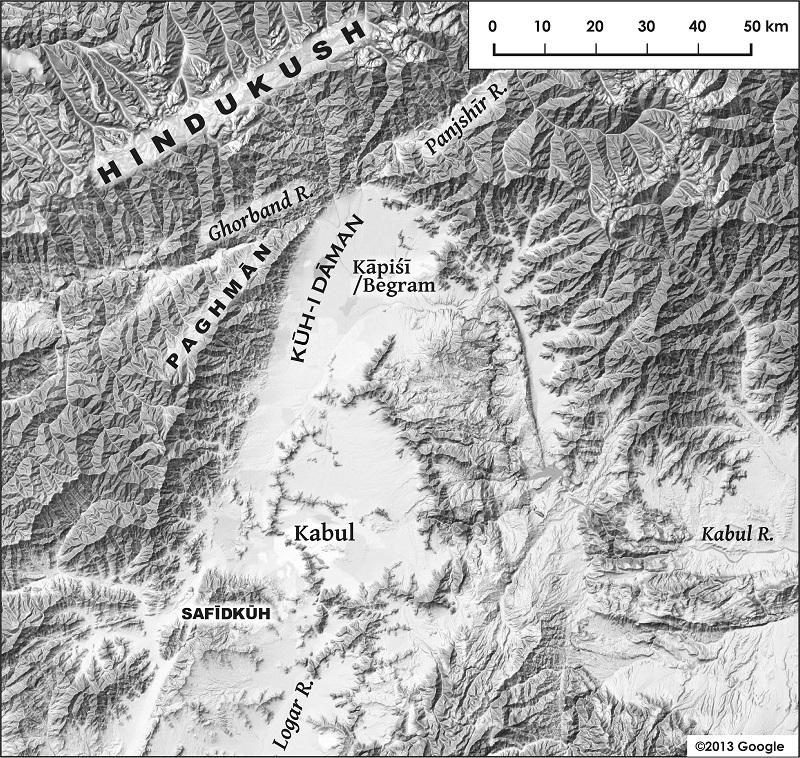
Fig. 3: Map of the Damān/Dāman mountain range mentioned in the documents as the post of the shiḥna (police). Originally published in Inaba, “Across the Hindūkush”, 145 (Map 5. Topography of Kāpiśī/Kābul). Modified by the present author and Mateen Arghandehpour. Courtesy of Minoru Inaba.
Conclusion
The letter is truly remarkable: it is a unique witness to the way tax collectors were audited themselves. Oversight is one of the most revealing points of comparison with other pre-modern tax systems, because it shows how different fiscal systems tried to control the same problem: how do you ensure that the people collecting taxes don’t appropriate them? Document NLI, Ms.Heb.8333.44 reveals that in Khurasan and the wider Islamicate world, oversight certainly existed—and that it operated through a mix of documentation, hierarchy, and complaint. Whether it existed through a fully systematised audit regime of the modern kind remains an open question.
Post-script: Enabling factors of tax misappropriation
What conditions might have enabled the tax collectors to use the taxes they collected in inappropriate ways? There are at least two obvious ones. The first enabler would have been the remoteness of the Damān valley far from the supervisory eyes of headquarters several days mounted travel away. The decentralised authority structure in the countryside and the challenges to communications and transport posed by the mountainous terrain shielded them from the long arm of central authority, and even from the oversight of their superiors in Bamiyan. The second enabler is that the police officers would have had much more direct access to large amounts of in-kind funds which they were holding in escrow, probably in smaller store houses. All this would have given the shiḥna considerable local power and autonomy. Jamāl al-Dīn Muḥammad b. Maḥmūd’s reserves were apparently quite extensive; perhaps he was involved in private enterprises on the side?
One document that hints at Jamāl al-Dīn Muḥammad’s activities records the debt of a person whose name is only partially legible (it ends in ‘-shāh’).10 This person sold 50 mann of high-quality wheat to Jamāl al-Dīn in an advance sale (wajh-i salam, Ar. bayʿ al-salam),11 with the goods to be delivered at a specified later date. The purchase price is not mentioned, but 50 mann is a small amount, 12 and the fact that such a small sale (and even smaller ones recorded in other documents) was documented in writing illustrates the detail and care with which records were kept and offers evidence of state-administered accountancy. The document stipulates that the wheat is to be delivered in one month’s time. The fairly quick turnaround is probably explained by the fact that the contract was concluded in late summer, close to the start of the harvest season. This is the very last document in the archive, written just before the Mongols’ brutal siege of Bamiyan, so whether Jamāl al-Dīn ever received his wheat is an open question.
The main point of interest for me in this particular document is Jamāl al-Dīn’s willingness to agree to a later payment against an advance from his account. It indicates that he had the reserves to cover what was effectively a loan. More evidence is provided by another document,13 in which a woman called Zulaykhā bt. Khwāja Jaʿfar acknowledges a debt of 90 mann of grain to the same shiḥna officer. Moreover, in a third document,14 a man confirms receipt of 100 mann of grain from Jamāl al-Dīn Muḥammad and pledges to pay it back when asked. The power dynamics are clear: the shiḥna had money and supplies, and the farmers relied on them for credit, possibly with exploitative mark-ups.
Another short but telling administrative note15 again features Jamāl al-Dīn Muḥammad, the shiḥna officer and collector of grain (muḥaṣṣil-i ghalla), as well as ʿAlī b. Abī Bakr, the warehouse manager. The document records a tax credit worth 50 mann paid by Jamāl al-Dīn for the village of Sūya and specifies that the amount is to be paid back as soon as the village can cover it. A postscript in the side margin adds that 33 out of the 50 mann were paid, probably at some later time. We thus see the shiḥna officer effectively providing a loan to farmers owing taxes to the warehouse.
Notes
1 It was reported in a 1963 letter written by Leo Mattersdorf eight years after Einstein’s death to Time magazine: “From the time Professor Einstein came to this country until his death, I prepared his income tax returns and advised him on his tax problems…One year while I was at his Princeton home preparing his return, Mrs. Einstein, who was then still living, asked me to stay for lunch. During the course of the meal, the professor turned to me and with his inimitable chuckle said: ‘The hardest thing in the world to understand is income taxes’. I replied: ‘There is one thing more difficult, and that is your theory of relativity’. ‘Oh, no’, he replied, ‘that is easy’. To which Mrs. Einstein commented, ‘Yes, for you’. Leo Mattersdorf New York City”. Time Magazine, 22 February 1963, “Letters: Feb. 22, 1963.” Time magazine digital archive, https://time.com/archive/6624156/letters-feb-22-1963, accessed 17/04/2026.
2 Chris Wickham, Framing the Early Middle Ages: Europe and the Mediterranean, 400–800 (Oxford: Oxford University Press, 2005), 70.
3 For more on the warehouse and its involvement in the rural administration of the Bamiyan jurisdiction, see our blogs: here and here. For a discussion of the formats of the tax documents in the Bamiyan corpus, and their close alignment to formats found in the Cairo Geniza, see Arezou Azad, “Documents Entangled: Tax Receipts from the Bamiyan Papers and the Cairo Geniza”, Fragment of the Month 5/25, Cambridge University Library.
4 For an example of such document, see NLI, Ms.Heb.8333.100 in the Invisible East Digital Corpus. For a more in-depth discussion of the legal documentary process that put tax collectors effectively “in debt” towards the diwan, see Arezou Azad with Pejman Firoozbakhsh, The Warehouse of Bamiyan: Economic Life in Medieval Afghanistan (Edinburgh: Edinburgh University Press, 2025), pp. 103–109.
5 Qudāma b. Jaʿfar, Kitāb al-Kharāj̲, edited by Michael J. de Goeje in Bibliotheca Geographorum Arabicorum, vi, 184–266 (selections from parts 5 and 6) and by A. Ben Shemesh in Taxation in Islam, ii: Qudāma b. Jaʿfar’s Kitāb al-K̲h̲arād̲j̲, Part Seven (Leiden: Brill, 1965).
6 Document 17 in the Appendix of Azad with Firoozbakhsh, The Warehouse of Bamiyan.
7 Zayn al-Ḥaḍra Abū Bakr, identified here as a sarhang (commander), does not appear in the other Bamiyan Papers available to us. Perhaps he was sent by the warehouse manager to Zīrdamān to escort the two shiḥna officers to headquarters.
8 Lit. az ʿuhda ... bīrūn āyand. This phrase is also attested in other documents (e.g. NLI, Ms.Heb.8333.71 and NLI, Ms.Heb.8333.75) and has been generally translated as “to meet (one’s) obligations.”
9 Lit. ḥuqūq-i dīwānī which may here refer to a fiscal policy that required the shiḥna to transfer the taxes they collect to the diwan. Ali Saffari understands the term to refer to tax payments specifically. Saffari, “Barrasī-yi kitāb-shināsāna”, Payām-i Bahāristān, Summer 1392/2013, 11–95.
10 NLI, Ms.Heb.8333.67 verso, dated Jumādā II 618/July–August 1221 (Document 26 in the Appendix of Azad with Firoozbakhsh, The Warehouse of Bamiyan).
11 An advance sale, also known as salaf, also appears in NLI, Ms.Heb.8333.62 (dated 1 Jumādā II 617/10 August 1220). Although this type of sale was deemed problematic by Muslim jurists because the merchandise being sold was not yet available at the time of the contract, it was accepted as valid on the basis of existing practice (ʿurf ). Lorenzo Bondioli discusses advance sales, agricultural production and the dynamics of rural debt in “Peasants, Merchants, and Caliphs: Capital and Empire in Fatimid Egypt” (PhD diss., Princeton University, 2021), esp. ch. 3, 106ff.
12 The unit of measurement mann is attested in medieval times and remains in use today, though its value has varied across time and space. Mirkamal Nabipour (drawing on the work of Walther Hinz) has argued convincingly that a mann was equivalent to 0.833 kg at the time the Bamiyan Papers were produced. Mirkamal Nabipour, “Die beiden persischen Leitfäden des Falak ʿAlā-ye Tabrīzī über das staatliche Rechnungswesen im 14. Jahrhundert” (PhD diss., Göttingen University, 1973), 1:3; Walther Hinz, Islamische Masse und Gewichte umgerechnet ins metrische System (Leiden: Brill, 1955). The measure changed in the early 14th century as a result of the reforms implemented by the Ilkhan Ghazan Khan (r. 694–713/1295–1304).
13 NLI, Ms.Heb.8333.77, dated 14 Shawwāl 615/9 January 1219.
14 NLI, Ms.Heb.8333.37 verso, dated Rajab [6]16/September–October 1219.
15 NLI, Ms.Heb.8333.112 verso, dated Shaʿbān 614/November–December 1217.


